How to store cigars: humidity, temperature and humidors
A humidor is a controlled micro-environment designed to protect premium cigars from the elements and allow their tobaccos to mature. Because tobacco is hygroscopic, it constantly absorbs and releases moisture. Without proper storage, a cigar will dry out and burn hot, or absorb excess moisture and become difficult to draw. Maintaining the correct balance of temperature and humidity is a scientific necessity, essential for preserving the oils and aromas of your collection.
The targets: why aim for 65–70% relative humidity and 16–20°C?
The generally accepted standard for storing Cuban cigars is 65 to 70 per cent relative humidity (RH) at a temperature of 16 to 20°C. For cigars intended for smoking in the near term, an RH closer to 70 per cent keeps the leaves supple and ready to light. For long-term resting and maturation, a slightly drier environment of 62 to 65 per cent is often preferred by collectors, as it encourages a slower, more graceful ageing process.
Temperature and relative humidity are inextricably linked. Warmer air holds significantly more moisture than cooler air. Consequently, to maintain the same absolute moisture content within a cigar (ideally around 13 per cent of its total weight), the relative humidity in the humidor must be adjusted based on the ambient temperature. The table below illustrates the relative humidity required to maintain this constant moisture level at various temperatures.
16°C (61°F) — Required Relative Humidity: 95%
18°C (64°F) — Required Relative Humidity: 84%
22°C (72°F) — Required Relative Humidity: 66%
24°C (75°F) — Required Relative Humidity: 59%
This relationship demonstrates that as the ambient temperature rises, the required relative humidity must be lowered to prevent the cigars from becoming over-humidified. In practice, achieving these exact theoretical ratios is difficult in a home setting. Maintaining a stable baseline within the 16–20°C and 65–70% RH range remains the safest approach for most collections.
The role of Spanish cedar
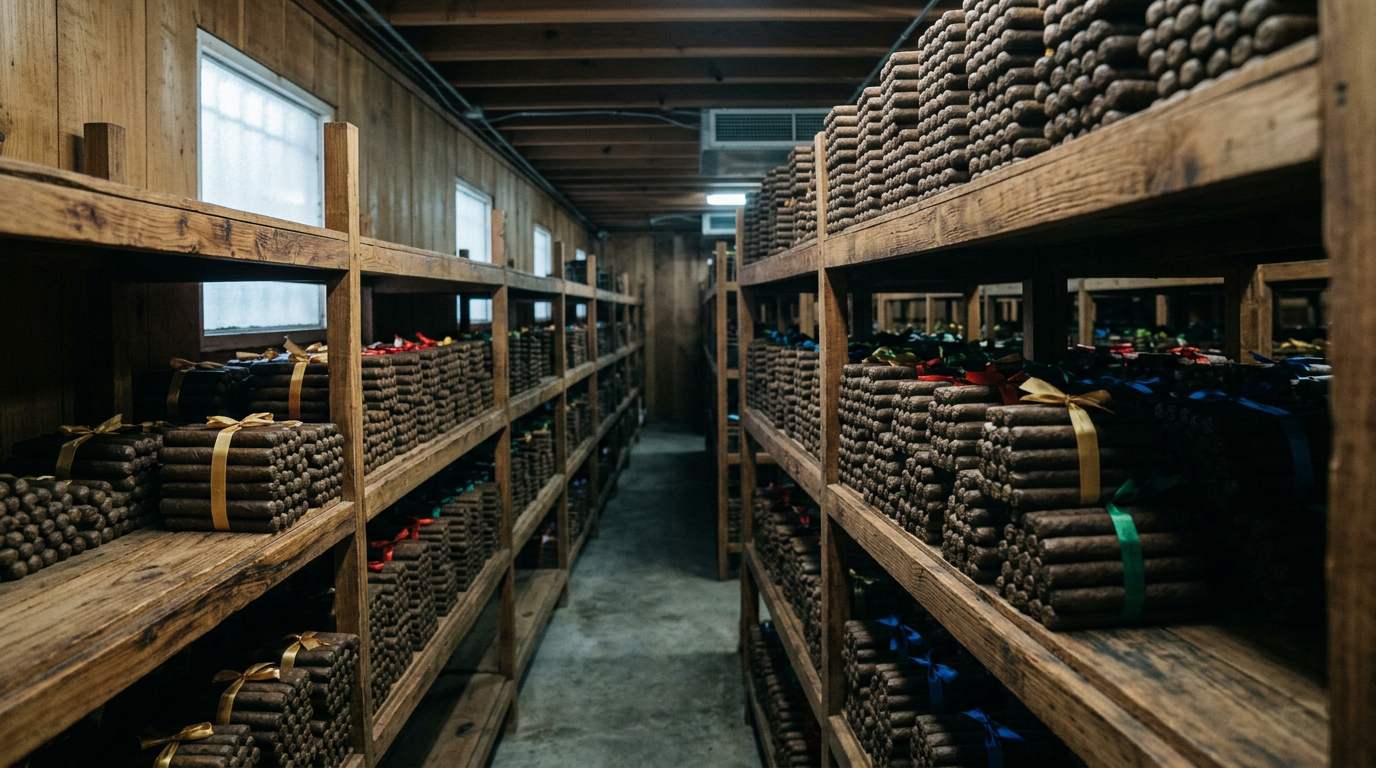
a cedar-lined ageing room (illustration) — Illustration, MokaCigar
The interior of almost all high-quality humidors is lined with Spanish cedar (Cedrela odorata). Despite the name, it is a deciduous tree from the mahogany family rather than a true coniferous cedar. Its exceptional porosity allows it to absorb and release moisture efficiently. This acts as a natural buffer that smooths out fluctuations in humidity.
Beyond moisture regulation, Spanish cedar imparts a slightly spicy, pleasant aroma that complements the tobacco and aids the maturation process. The strong, resinous scent also serves as a natural deterrent to the tobacco beetle (Lasioderma serricorne), a pest that can ruin an entire collection. Occasionally, the wood may exude a sticky resin. This is a natural characteristic and can be carefully removed with a cloth lightly dampened with acetone.
What are the different types of humidors?
For most smokers, a wooden desktop humidor is the primary storage vessel. These range in capacity from twenty to several hundred cigars. Quality construction is indicated by thick walls, heavy quadrant hinges, and, most importantly, a tight seal that prevents air exchange. Cabinet humidors offer larger capacity for serious collectors, often incorporating active electronic humidification and holding hundreds of cigars in their original boxes.
A walk-in humidor, or escaparate, is the ultimate storage solution, typically found in specialist merchants and built as a fully climate-controlled room. For short-term transit, a travel humidor is essential. Those made of shatterproof ABS plastic with a silicone seal provide watertight and airtight protection, making them superior to leather cases for rugged travel. Alternatively, a 'tupperdor'—a food-grade plastic container with an airtight seal—offers a functional and cost-effective method, provided it is fitted with a reliable humidification device and kept out of direct sunlight.
How to season a new humidor
Before placing cigars in a new wooden humidor, the dry Spanish cedar must be seasoned. If this step is skipped, the thirsty wood will draw moisture directly from the cigars, drying them out. The seasoning process establishes the necessary moisture baseline within the wood itself.
Begin by gently wiping all interior cedar surfaces with a new, lint-free cloth lightly dampened with distilled water. Never use tap water, as the minerals can clog the pores of the wood and encourage mould. Place a small dish of distilled water inside the empty humidor, close the lid, and leave it for several days. Once the hygrometer reading stabilises at your target humidity, the humidor is ready to receive cigars.
Humidification systems and hygrometer calibration
Maintaining the climate requires a reliable humidification system. Traditional passive systems use a floral foam sponge charged with a mixture of distilled water and propylene glycol, but these can be imprecise and prone to bacterial growth. Acrylpolymer crystals offer an improvement, as they self-regulate to absorb or release moisture, maintaining a more stable environment.
Two-way humidity control packs, such as those made by Boveda, are now the standard for most collectors. These sealed pouches contain a saturated salt solution that precisely maintains a specific RH level without any maintenance other than replacement every two to three months. Active electronic humidifiers, which use sensors and fans to distribute moisture, are best suited to large cabinets.
Monitoring the environment requires an accurate hygrometer. While digital models are generally reliable, analog and adjustable digital hygrometers should be calibrated using the salt test. Place a bottle cap containing a thick slurry of table salt and a few drops of water into an airtight bag alongside the hygrometer. After eight hours, the atmosphere will reach exactly 75 per cent relative humidity, allowing you to adjust your hygrometer to match this reading.
Resting, ageing, and common concerns
A properly maintained humidor allows boxes to keep indefinitely, with many premium Habanos improving over decades. When purchasing cigars, a resting period of at least two to four weeks in your humidor is advisable to allow them to acclimatise. If you are buying boxes with the English Market Selection (EMS) stamp, you can be assured they have been stored correctly by the exclusive UK importer.
Always check the box code stamped on the bottom of the cabinet or dress box—our box code guide explains how to read these—to determine the age of the cigars. This date is the starting point for your maturation process. To ensure the integrity of your collection, it is also wise to understand the hallmarks of genuine packaging by consulting our guide on how to spot fake Cuban cigars. Long-term ageing allows the tobaccos to marry, softening harsh tannins and developing complex flavours.
Collectors must remain vigilant against the tobacco beetle. These pests thrive in temperatures above 22°C and can quickly decimate a collection. If you suspect an infestation, evident by perfect pinholes in the wrapper leaf or fine dust in the box, the affected box must be isolated immediately. Place the cigars in airtight bags and freeze them for 72 hours to kill any eggs or larvae, then move them to the refrigerator for a day before slowly returning them to the humidor.
It is also important to distinguish between plume and mould. Plume is described as a harmless, crystalline substance that forms on the wrapper of well-aged cigars as oils rise to the surface, though its existence is debated among modern collectors. Mould, however, is a definite threat that appears as fuzzy, web-like, or green and blue spots, usually caused by excessive humidity. If mould is found on the foot of the cigar, it has penetrated the filler leaves and the cigar must be discarded.
At MokaCigar
Proper storage is the foundation of collecting Habanos. We ensure all our cigars are kept in optimal conditions within our climate-controlled escaparate, verified for authenticity, and rested before dispatch. If you are beginning your collection or looking to upgrade your storage, explore our selection of accessories to find the correct equipment for your needs.